Sunday, August 14, 2016
Washington, DC House History Map Updated!
Well, it took us three years due to a house and office move of late, but its here! We've updated the Google Maps that chart the locations, along with a wee bit of history, of each house and building we have researched. Check it out, and discover the history of a house near you!
There were so many that Google used to have a limit, so we have two maps:
Houses and Buildings in NW DC
Houses and Buildings in SE, SW, and NE DC
As you can see, we've been busy of late. Enjoy!
Sunday, July 17, 2016
The Unusual Origin of Howard University By One of Its Founders, Charles Boynton
| Boynton Mansion at N Street and Vermont Avenue, NW |
The first President of Howard
University, Charles B. Boynton, took office on March 19, 1867, marking the
official beginning of the esteemed institution that had been conceived in his
house near the intersection of N Street and Vermont Avenue earlier that year. His contemporaries called him “President of
the Board of Trustees,” and his tenure would be short; he resigned on August
27, 1867 over a dispute with namesake Otis O. Howard stemming from their
differing racial policies.
Charles Brandon Boynton (left, via NARA) had been born
in Stockbridge, Massachusetts, on June
12, 1806. He entered Williams College in
the class of 1827, but, owing to illness, was obliged to leave during his
senior year. He took up the study of
law, and, after filling one or two local offices, was elected to the
Massachusetts legislature. While
studying law he became interested in religion, qualified himself for the
ministry, and was ordained pastor of the Presbyterian Church at Housatonic,
Connecticut, in 1840.
After a stay of three years, he moved to churches in Lansingburg and
Pittsfield, Massachusetts, and in 1846 to Cincinnati, Ohio where he remained
until 1877; with the exception of his terms of service as chaplain of the House
of Representatives in the 39th and 40th congresses (1867-1869), while he
resided at N Street and Vermont Avenue. Boynton had earlier ventured to
Washington to serve as the first pastor of the First Congregational Church upon
its founding in 1865.
On November 20, 1866, ten members,
including Howard, of various socially concerned groups of the time met in
Washington, D.C., to discuss plans for a theological seminary to train colored
ministers. Interest was sufficient, however, in creating an educational
institute for areas other than the ministry. The result was the Howard Normal
Institute for the Education of Preachers and Teachers. On January 8, 1867, the
Board of Trustees met at Boynton’s house and voted to change the name of the
institution to Howard University.
Boynton bore an important part in the anti-slavery controversy, which was
fiercely waged in Cincinnati during the early years of his pastorate. His published books include Journey through Kansas, with Sketch of
Nebraska (Cincinnati, 1855); The
Russian Empire (1856), The Four Great
Powers--England, France, Russia, and America; their Policy, Resources, and
Probable Future (1866); and History
of the Navy during the Rebellion (New York, 1868).
A strict abolitionist, Boynton and Major General Otis O. Howard (1830-1909)
had differing views of the very early forms of segregation immediately
following the Civil War, despite their common goal of providing affordable education
for black citizens at the collegiate level.
On November 17, 1867, Boynton preached a sermon on race relations in
which he advocated that blacks be allowed to enter churches of white
congregations and become members, but where existing black churches were
located he encouraged them to remain and strengthen their own religious
institutions, advocating voluntary segregation.
Howard, on the other hand, mandated integration at every society level.
Boynton also advocated the self reliant “city within a city” theory of
advancement, opportunity, and business patronage that black leaders lectured in
the 1920s along U Street. In 1867,
Boynton preached that “every one taken thus from the number of the black,
diminishes to that extent, their strength and their power of progress and
elevation. We can afford to receive the
Colored people, but their own race can not afford to lose them.” (From Walter
Dyson’s Howard University: A History,
1941)
Howard and his followers continued to publicly push for racial
integration in all aspects of private and public life, and Boynton left the
position as both pastor of the First Congregational Church September 6, 1867, and
as the first President of Howard University, a month earlier on August 27, 1867. He was replaced by Byron Sunderland until Otis
O. Howard became President a year later, in 1868.
Boynton’s son, Henry Van Ness Boynton, below, was a well known newspaper
correspondent that built the house at 1321 R Street between 1875 and 1879,
where he and his father lived in 1880, according to the federal census (left, in 2007). Henry Boynton charged Otis Howard with
misappropriating funds from the Freedman’s Bureau which he controlled, and a
federal investigation ensued in 1870 to determine if Howard directed funds
donated to public institutions such as Howard University to promote his own
namesake. As commissioner of the Freedmen's Bureau, Howard was known for
promoting the welfare and education of former slaves, freedmen, and war
refugees.
By 1870, an astonishing $529,000 from
the Bureau’s coffers had been donated to Howard University, where twenty other
black schools such as Lincoln University had only received $15,000. The issue softened, and Howard himself served
as the University’s President from 1868 to 1874.
Charles Boynton died
in Cincinnati, Ohio, on April, 27, 1883; his son, Henry Van Ness Boynton
died at 1321 R Street in 1905. Mordecai Wyatt Johnson (1890-1976)
later served as Howard University’s first black president, and its thirteenth,
from 1926 until 1960.
Copyright Paul K. Williams
Sunday, May 15, 2016
Almost Razed: History of the 1700 Block of Seaton Place, NW
| Seaton Place, 1949 |
In what is coined the Strivers Section today, the 1700 block of Seaton Place, located between U, V, 17th Streets and Florida Avenue, was first developed in the early 1870s, and completed by 1908. It was the subject of noted photographer Gordon Parks in 1942, as part of his work documenting the effects of racism and poverty for the Farm Security Administration, seen below. Adjoining both the Greater U Street and Dupont Circle Historic Districts, the Strivers Section Historic District was recognized and listed as a local historic district in 1983.
Seaton
Place today was initially coined Riggs Street, as seen on an 1887 map of Square
150. It was then renamed a short time
later to Seaton Road, in honor of William Winston Seaton, mayor of Washington
from 1840 to 1850. Later, its name was
changed to Seaton Place.
The oldest buildings along the one
block street are located at 1701 to 1719
Seaton. Erected between 1872 and 1873,
this row of ten, two-story brick dwellings featured raised basements and Italianate
detailing including a bracketed wood cornice.
Another group of rowhouses on the south side at 1700 to 1716, were also
built relatively early, from 1874 to 1875.
It originally consisted of a row of ten, two-story, flat fronted brick
dwellings on high foundations to appear as if it were one long building. The end buildings at 1700 and 1716 were
articulated as “end pavilions” with projecting center gables, with the center
buildings forming the main block of the group.
Today, the homes are all painted different colors, and one end pavilion
(#1716) is no longer standing.
Development
on the Street ceased for nearly fifteen years, until 1890, when the thirteen
rowhouses between 1741 and 1757 Seaton Place were built simultaneously by builder
James H. Grant as speculative housing.
The five townhouses from 1731 to 1739 Seaton were also built in 1890, by
owner John C. Davidson, with the assistance of architect George S. Cooper. The 1900 census reveals that all the built
segments of Seaton Street at the time housed “Black and Mulattos”
occupants.
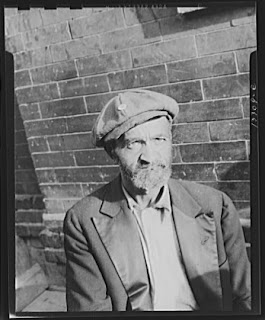
| Peanut seller, by Gordon parks |
However,
much of Seaton Place remained vacant until 1902, most likely due to the
economic depression of 1893 and 1894, and the years of recovery that
followed. Eighteen houses were built that
year by owner Charles W. King with the assistance of architect Nicholas T.
Haller, comprising 1722 to 1758 Seaton Place.
The three large townhomes at 1723, 1725, and 1727 were built in 1905 as
“townhouse flats” by building partners
Jos. J. Moebs and H..J. O’Connor. Each
included an apartment that was indicated by using a 1/2 after the residential
address. The two estimated the three
dwellings would cost $7,000 to build, or approximately $2,333 each. The last house built to complete the block
was 1720 Seaton Place, built in 1908 by owner C.T. Bride with the assistance of
architect J.G. Adkinson and builder J.T. Loveliss. The 1920 census reveals that all the
residents along Seaton Street were “Black or Mulatto” working class citizens at
the time.
Apparently,
from the late 1940’s to the late 1970’s, Seaton Street, was the focus of
disagreements between tenants, home owners, and the city government over the
terrible conditions of the houses. It
was well documented as part of the 1942 Farm Security Administration’s “New
Deal” Program, and later in an essay on Wartime Washington by photographer
Gordon Parks (b. 1912), whose photographs are now housed in the Library of
Congress. Recognized as the first major
black photojournalist, Parks later went on to become a staff photographer for Life magazine.
In the
August 3, 1950 edition of the Washington Star, a short notice appeared
indicating the anticipated revival of Seaton Street and the entire Square 150,
containing an slightly amusing statement on the street itself:
Square 150 Rehabilitation Unit to Resurvey Job
The Commissioner’s Committee appointed to rehabilitate
Square 150 will make a resurvey of the block next Monday, E.M. Dulin, chairman
announced today.
Square 150 is bounded by U, V, and 17th streets and
Florida avenue, N.W.
There are 124 buildings in the square, and 20 of them
have been or are in the process of being repaired. The
worst part of the square is Seaton street, which runs from Seventeenth
Street to Florida Avenue, N.W.
Nine years
later, on 25 September 1959, the Washington Daily News ran a story by
Martha Strayer with a by-line coined “Massive Aid: the World Comes to a D.C.
Street.” In an effort to better
conditions, almost every department in the government made a commitment to
provide education, better sanitation, and relief to the unimaginable
conditions. At the time, the one block
Street housed 200 children!
The
“acknowledged block of blight” was saved demolition in 1965, when the National
Capitol Planning Commission voted against the idea in February of that
year. According to a 2 May 1965 article
in the Washington Post, the reason given was the lack of public housing
for the 130 families on the block at the time.
Commission staffers still wanted to revitalize the Adam’s Morgan area,
and at one time investigated purchasing the empty property at 16th and Florida,
previously “Henderson Castle,” a mansion that had been demolished in 1949.
At least
some of the residents won the lawsuit in the D.C. Superior Court (10 of the
original families) in April of 1977, and had a short time to raise funds to
remain in their homes. In May of that
year, at least nine of those families were able to purchase their homes,
according to a 30 November 1978 article in the Washington Post, a few of whom can still be proudly found on the block today.
Copyright Paul K. Williams
Saturday, April 09, 2016
History Mystery: Steamer Trunks of the Grant Family
Many years ago, an owner of 1711 New Hampshire Avenue, NW
approached us with a history mystery; she had found several steamer trunks with
the name ‘Grant’ painted on them, and wondered if it were at all possible they
could have once belonged to the Ulysses Grant family. We not only found the connection, but found a
Russian Princess to boot.
The house had been built in 1911-1912 at a cost of $25,000 by
Franklin Sanner, who was developing other large properties close by as
speculative development. It was designed
by Albert Beers.
Owner Sanner sold the residence to Ida Honoré Grant on
September 17, 1912, as recorded Liber 3547, Folio 366. She listed herself in
the 1915 City Directory as the widow of Frederick Dent Grant, the eldest son of
famed Civil War General and President Ulysses S. Grant, and was from a wealthy
and prominent Chicago family. She was listed as the sole resident at the address
in the 1913 City Directory. The couple is pictured at right.
As the son of Ulysses S. and Julia Dent Grant, Frederick Dent
Grant was born on May 30, 1850, in St. Louis, Missouri. He attended West Point
Military Academy, graduating with the class of 1871. He was assigned on June
12th of that year to the Fourth United States Cavalry, spending two years on
outpost duty taking part in combats with Indians in the far west. As a result,
he was promoted to the rank of First Lieutenant and Lieutenant-Colonel by 1873,
and eventually resigned his military commission in June of 1881.
Shortly thereafter, he married Ida Honoré, the daughter of a
Chicago millionaire. They resided in New York with the widow of General Grant.
He served as republican Secretary of State for New York from 1887 to 1888. Also
during this time, Frederick served as minister to Australia, and was Police
Commissioner of New York City at the outbreak of the Spanish War, when he
became Colonel of the Fourteenth New York Volunteer Infantry, and was soon
thereafter appointed a Brigadier-General of the United States Volunteers.
During the Spanish War, he served in Puerto Rico, and
following the war, remained in command of the military district of San Juan.
Shortly thereafter, he transferred to the Philippines, commanding the Second
Brigade of the First Division of the Eighth Army Corps. While there, he took
part in the battles of Big Bend and Binacian, afterward being transferred to
the Second Brigade of the Second Division, advancing on Northern Luzon and
Zamballes.
He returned to the States in 1901 when he was appointed a
Brigadier General in the United States Army and assigned to command the
Department of Texas, with headquarters in San Antonio. In 1902, he was transferred
once again to the Philippines, to the Sixth Separate Brigade in Samar, where he
received the surrender of the last insurgent forces.
In 1914, Ida H. Grant apparently rented the house to U.S.
Senator William P. Jackson (left) and his wife, as they were listed as the
occupants in the City Directory for that year. Incidentally, another William P.
Jackson appeared in the same City Directory, and listed his profession as an
Assistant Inspector General in the United States Army, boarding at the Army and
Navy Club.
The daughter of Ida H. and Frederick Grant, Julia, was born in
the White House in 1876, while her father was fighting in the Indian Wars in
the West. Her grandfather, Ulysses Simpson Grant, was then serving his second
term as President. She grew up in Vienna where Frederick later served as the
American minister to the court of Emperor Franz Joseph.
In 1899, at the Newport, Rhode Island home of her aunt, Mrs.
Potter Palmer of Chicago, Julia Grant was married to Prince Michael Cantacuzene,
chief military adjutant to Grand Duke Nicholas, the grandson of Tsar Nicholas
I. For the following eighteen years, she lived on her husband’s vast estates
near St. Petersburg and in the Crimea until the Russian Revolution forced them
to escape to Sweden.
Princess Cantacuzene, as she preferred to be known, became the
frequent lecturer and author of three books, all relating to her life in Russia
before and during the Revolution. As a popular lecturer, she was an outspoken
foe of Communism as well as of the New Deal during the 1930s and 1940s. In
1934, she regained the American citizenship she had given up at her marriage
thirty five years earlier. She died in 1975 in the Dresden Apartment building
at 2126 Connecticut Avenue at the age of ninety-nine. Interestingly, it was designed by Albert H.
Beers in 1909, just two years before he designed the house of her mother at
1711 New Hampshire Avenue.
The son of Frederick Dent and Ida Honoré Grant, Ulysses S.
Grant III, was born on July 4, 1881 in Chicago. He too was raised primarily in
Vienna, attending the Thresianum school there before attending the Cutler
School in New York City and Columbia University in 1898. He graduated from
Westpoint Military Academy in 1903, and graduated from the U.S. Engineer’s School
in 1908. He married Edith Root, daughter of the Secretary of State Elihu Root,
the Secretary of State under Theodore Roosevelt on November 27, 1907, and
together they lived in San Francisco.
He became a D.C. resident in 1925, and lived at 2117 LeRoy Place,
N.W., when he became active in numerous urban planning affairs, including
serving as the Executive Director of the National Capitol Park and Planning
Commission. At the time of his death in 1968, he maintained a residence at 1255
New Hampshire Avenue, N.W.
The last will and testament of Ida Honoreé Grant has several
inclusions that offer insight into the lifestyle that she led while in
residence at 1711 New Hampshire Avenue, N.W. It was written on September 2,
1926, and entered into probate on September 8, 1930, shortly following her
death.
The real estate at 1711 New Hampshire Avenue was willed
exclusively to her son Ulysses S. Grant III (left) upon Ida Honore Grant’s death in
February of 1930.
Her daughter Julia Grant Cantacuzene and son Ulysses S. Grant
III were to split most of the personal artifacts and furnishings of the home,
including "all clothing and wearing apparel, jewelry and articles of
personal use and adornment, books, pictures, bric-a-brac, silver and household
furniture, articles and effects, of every kind and description, as well as any
other tangible personal property and effects, of which I may die
possessed." Ida was also proud that she was able to keep the aggregate
value of multiple bonds "intact and equal to the value of said property at
the time it was left to me, so that I might be able to make this bequest and
pass it on...to our children." The bonds in question were housed in her
safe deposit box at the American Security and Trust Company in Washington, D.C.
It was her wish that the children would be able to retain the bonds at their
face value to pass on to their children in remembrance of their father
Frederick Dent Grant.
The remainder value of the estate was to be placed in a Trust
at the American Security and Trust Company and equally dispersed over the
course of 21 years in equal parts to her son and daughter. She expressed the
trustees "to be very conservative, and to purchase only such bonds or
other securities, which, after careful investigation, they believe to be safe and
secure. I prefer that my trustees invest in such securities rather than in real
estate."
Her daughter Julia was specifically granted the sum of $50,000,
to be gleaned from the proceeds of the sale of real estate owned in the state
of Illinois. She also noted that her daughter was "amply provided for by a
trust created by my sister, Bertha Honoré Palmer, which Trust has greatly
increased in value through the able management of my brother, Adrian C.
Honoré."
To her son, she specified that "all letters and papers of
an official, business or personal character owned by me, including those which
belonged to his father, and also those which belonged to his grandfather,
General Ulysses S. Grant." She made that bequeath "in order to carry
out my late husband's express wish that his son should possess these letters
and papers."
The Nicaraguan Legation: 1931 to 1936
The residence at 1711 New Hampshire was rented by Ulysses S.
Grant III following the death of his mother Ida Honoré Grant in early 1930 to
the Government of Nicaragua for us its Legation. The Charge d’Affaires of
Nicaragua at the time, Dr. Henri De Bayle, both resided and worked at 1711 New
Hampshire Avenue, N.W., during this period.
Copyright Paul K. Williams
Saturday, February 13, 2016
History of the odd Ffoulke Mansion at 2013 Massachusetts Avenue, NW: A Man and His Tapestries
One might be hard pressed to
assign an author a combined article about Welsh ancestry, Quaker religion, antique
tapestries, Royal weddings, early retirement, and even Pope Urban VIII, but
they are all integral to one mansion that once stood at 2013 Massachusetts Avenue,
NW. It was built in 1886 on the site of
what today is the Hilton Embassy Row hotel just west of Dupont Circle.
The house was speculatively built by
developer Brainard H. Warner and designed by James G. Hill in 1886. Built at a cost of $11,000, it was purchased
shortly thereafter and vastly expanded by owner Charles Mather Ffoulke
(1841-1919). He had an addition added
onto the eastern side that nearly doubled the house for one specific purpose:
to display his growing collection of 17th Century antique
tapestries.
Ffoulke was born in Quakertown,
Pennsylvania, on July 25, 1841, the son of Benjamin Green and Jane (Mather)
Ffoulke. For generations, both his
maternal and paternal families had been known as “counselors of the peace”
being land surveyors and conveyancers charges with the amicable settlement of
disputes common with early land settlement and development in and around Bucks
county, Pennsylvania among the fellow Quaker inhabitants. His father gained credibility with the North
Pennsylvania Railroad when he negotiated a new right of way for the extensive
track system with hundreds of families that resulted in not one single lawsuit. The Ffoulke family received their own land in
Quakerstown by a grant from William Penn.
Following a short teaching career in
Quaker schools, Charles Ffoulke entered the wool business in Philadelphia in
1861. It was wildly successful, and he
retired just eleven years later, in 1872.
He set off on an extended two year vacation to Europe to study art and
tapestries, and married Sarah A. Cushing in Paris on December 10, 1872. He crisscrossed the Atlantic several more
times between 1874 and 1884, before embarking on a five year tour beginning
that year. He had five children who included: Horace Cushing, Helen Seagrave,
Gladys, Gwendolyn, and Charles M. Jr.
Ffoulke had nearly completed a long manuscript
entitled “General History of Tapestries” when it was accidently destroyed and
he began to work on the tome all over again.
He also compiled a book on the art tapestries of America, and a book
entitled “A History of the Barberini Collection of Tapestries,” which
apparently caught his fascination: he purchased the entire collection of 135
tapestries in its entirely in 1888. The
collection had begun in 1610 by Italian Cardinal Francesco Barberini
(1597-1679), aided by his uncle, Pope Urban VIII, and had largely been
assembled by 1690. They were considered
the most important, varied, and extensive collection of tapestries to be owned
by a private citizen at the time. Urban
VIII was not only a Pope, but exercised temporal sovereignty over an extensive
part of central Italy.
Ffoulke had to store most of the
collection in a rented Convent in Florence, however, because of the high excise
tax imposed on antiques of such value when they entered the United States. Only his most prized tapestries were brought
to hang in the gallery at the Massachusetts Avenue house, or temporarily lent
to museums around the globe. That
gallery also hosted weddings for his daughters, who each married visiting
Diplomats and Royal descendants from all parts of Europe.
Ffoulke died suddenly in New York
City on April 14, 1909, but his widow continued to reside at 2013 Massachusetts
Avenue until the late 1920s. The
tapestries were sold to various wealthy individuals, including Phoebe Hearst,
and John R. McLean, among others, and today have mostly found their way into
museums and churches such as the Cathedral of St. John the Devine in New York
City.
Like many large houses in
Washington, the Ffoulke mansion was transformed into a boarding house during
World War II for the onslaught of government workers. Photographer Esther Bubley captured those at
2013 Massachusetts Avenue in January 1943 for an Office of War Information
project and noted that it the “schedule for use of the boardinghouse bathroom
is worked out so that each person has eight minutes in the morning. It is social suicide to ignore the schedule
and cause a tie-up like this.” Shown in
the picture are Enid Bubley, Roselyn Silverman, and Bluma Horowitz at Dissin's, a boarding house at 2013
Massachusetts Avenue, NW that catered to “young Jewish people.” (Library of Congress, Prints and Photographs
Division)
Copyright Paul K. Williams
Subscribe to:
Posts (Atom)