Showing posts sorted by relevance for query zoo. Sort by date Show all posts

Saturday, April 22, 2017

Entertainment for the Animals at the National Zoo


A five member band and a dancer entertain the polar bears in the 1920s. 

Since the National Zoo’s inception in 1889, many Woodley Park residents, including those at the nearby Kennedy-Warren apartment building, have awoken to the sounds of lions growling, wolves howling, and other animal noises from their four-legged neighbors.  Designed by the famed architectural landscape firm of Frederick Law Olmstead, who was also responsible for the design of Central Park and the U.S. Capitol Grounds, the National Zoo has evolved from a showcase of the world’s exotic species to a conservation organization, public education pioneer, as well as a scientific research organization.   Of course, adorable pandas, monkeys, and tigers are still the main attraction.

Charles Trevey bakes huge loaves of bread for the bears in August of 1922
Created by an 1889 Act of Congress for "the advancement of science and the instruction and recreation of the people," the National Zoo became part of the Smithsonian Institution in 1890.  In addition to the main 163-acre urban park in the Rock Creek Valley, the Zoo also has a 3,200-acre Conservation and Research Center in Front Royal, Virginia.  The Zoo's spacious and picturesque area marked a significant departure from the 19th century philosophy of creating zoos in small areas.  Due to its origin prior to the creation of New York's Zoological Park and Munich's Hellabrun Zoo, the National Zoo may have been the first zoo to be located in such a spacious park-like setting.

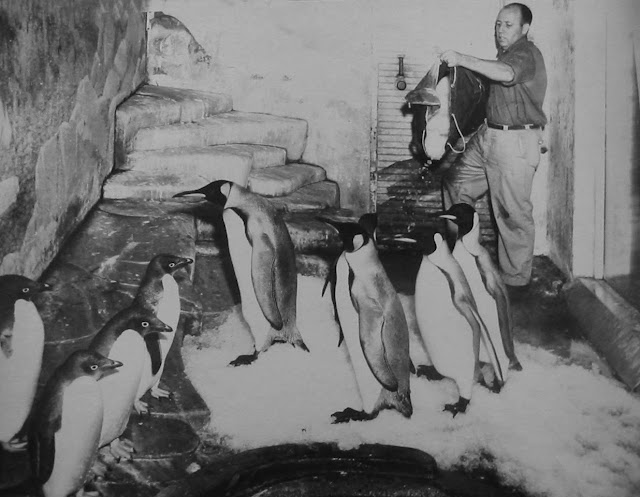
A little ice is provided tot he penguins by bird keeper Holmes Vourous in 1954
Plans for the Zoo were drawn by three individuals — Samuel Langley, third secretary of the Smithsonian; William Temple Hornaday, a conservationist and head of the Smithsonian's vertebrate division; and Frederick Law Olmstead, a leading landscape architect who designed Central Park in New York.   Historians at the zoo, however, indicate that the first recorded live animal gift to the nation occurred in 1785, when Charles III of Spain sent a “royal jackass” to George Washington while he resided at Mount Vernon.  

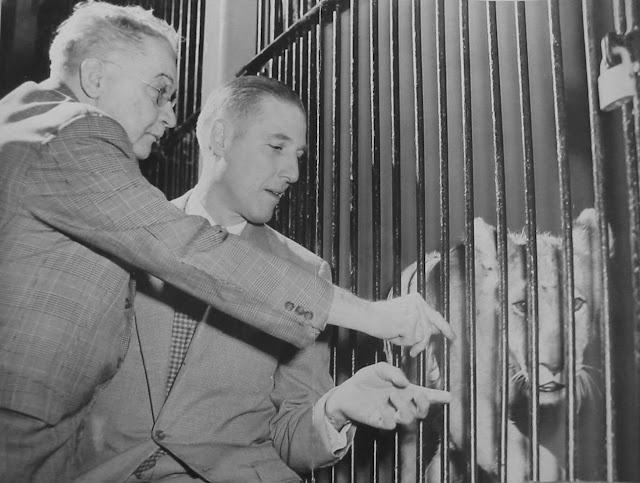
Watch those fingers - Director William Mann (left) and Wm Mileham in January 1951
The Zoo has been at the forefront in striving to expand the public's knowledge of the wildlife and the environment through public education programs aimed at teachers and school children, with images of Victorian school children common in the collection of zoo images at the Library of Congress.  The first animals at the facility were literally captured in the wild and brought back to Washington.  The zoo also strove in the early years of its existence to create a refuge for buffaloes and other animals that were quickly disappearing from the North America landscape.  The present monkey house, the New Mammal House, and the lion house are the only two original Zoo buildings that remain today.

A Chimpanzee enjoys a refreshing bottle of milk in May of 1926
Despite Washington's long, humid summers, polar bears seem unaffected by the heat at the National Zoo.  Past polar bears have resided at the Zoo for more than 25 years without showing ill affects of the heat.  This wacky photograph shows staff members swimming in their pool in 1973.    The chimpanzees are known to be one of the easiest species for the Zoo to exhibit due to their pleasant demeanor and friendly attitude toward spectators and keepers.  Others were no so easily contained: Kechil, a ten-year-old elephant that had been caught in Sumatran, was known in 1932 as the "bad boy" of the park, able to throw “with good aim rocks which have been tossed into his enclosure, and has been known to hit visitors on the head,” according to a 1936 book on the zoo. 
The first director of the zoo, Wm Blackburne, who served for more than 40 years, with a gorilla named N'Gi


Tuesday, February 28, 2012

DC in Wacky Photos: Polar Bear Pool Swim at the Zoo

One of my favorite 'Wacky Washington' Pictures from my Woodley Park book, co-written with Gregory J. Alexander.

In August of 1973, National Zoo staff members take a welcome plunge in the 171,000 gallon polar bear exhibit pool.  Lucky for them, the bears wouldn't arrive for two more weeks.


Thursday, March 01, 2012

Mystery: Miss Manners Childhood Home in AU Park?


4826 Davenport Street, NW
I love it when a homeowner in Washington, DC contacts us to investigate if a rumor they heard from an old neighbor is really true.  Especially if that involves a famous person, as did the owners of 4826 Davenport Street, who conveyed with much trepidation that they had heard their house was the childhood home of the beloved columnist Miss Manners – aka Judith Martin - could it be true?  “Anything is possible,” I replied, and we went to work.        

The first thing I investigated was to find out what her real name was, and approximately how old she was.  Then we went to work on the house itself, when it was built, and creating a successive line of owners or renters.  The thought of composing a letter to Miss Manners left me many sleepless nights: how on Earth does one get it just right? Typed or hand written?     

Miss Manners
The house at 4826 Davenport Street was by William B. Pichler and William Richmond of the Pichler-Richmond Construction Company, who received a building permit on October 2, 1936.  They listed themselves as the builders, and William Crusemire as responsible for its design.  It was to be constructed for an estimated cost of $6,000.   

An advertisement for the house appeared in the Washington Post on January 10, 1937, when it was listed for $11,650.00 by real estate agent Clifton D. Kelley.  Pichler & Richmond sold the newly completed house on February 10, 1937 to Jacob and Helen A. Perlman.  They obtained a mortgage in the amount of $9,000, and a second mortgage in the amount of $7,000 that was due in three years.  The Perlman’s would own the house for the next eighteen years, until 1955.  

There was the answer: Miss Manners was born Judith Sylvia Perlman!  But, we had to make sure we had the correct Perlman family, as there were dozens in Washington at the time.  Either way, the Perlman family that purchased 4836 Davenport Street was turning out to be quite interesting.    

Jacob Perlman was born on May 10, 1898 in Byalostock, Poland.  He immigrated to the United States in 1912 with his father, Mordecai (aka Max) and mother Pauline to Madison, Wisconsin and became a naturalized citizen in 1918.[1] They had been invited by their brother Selig, who had already begun a lifelong academic career at the University of Wisconsin.
 
Jacob’s WWI Draft card (below), filled out on September 12, 1918 indicated that he was of medium height, slender build, with brown hair and light colored eyes.[2]  He graduated from the University of Wisconsin in 1919, and spent the next two years as statistician of the New York State Department of Labor.  He was listed as a lodger at 1156 Brookline Avenue in Albany, NY in the 1920 census, and indicated that his native language was Yiddish.   

In 1921, Perlman returned to the University of Wisconsin for graduate studies and to teach in the Economics Department.  He obtained his M.A. in 1922 and his Ph.D. in 1925.  Perlman moved to Washington, DC in 1933 as a staff member of the Committee on Government Statistics, and married Helen Aronson in 1935.